




What is an active galaxy?
An active galaxy is a galaxy (a huge group of stars, dust, gas, and other celestial bodies bound together by gravitational forces) that produces huge amounts of energy; they produce more energy than the total energy emitted from each of the stars in the nebula. There may be at least three types of active galaxies, including Seyfert galaxies, quasars, and blazars (although they may be the same type of galaxy view from different distances and perspectives).
Seyfert Galaxy
A Seyfert galaxy is an active spiral galaxy. Its nucleus (center) has bright emission lines, including visible wavelengths. The brightness varies over relatively short time periods (less than a year). They may have massive black holes at their centers. Seyfert galaxies were first described by Carl Seyfert in 1943.
Quasar
 A quasar (more recently known as a QSO, Quasi-Stellar Object) is a distant star-sized energy source in space with an excess of ultraviolet radiation. Some of these QSO’s gives off large amounts of radiation, including radio waves and X-rays (but some are radio-quiet). The word quasar is short for quasi-stellar radio objects. Quasars were discovered by Allan R. Sandage in 1964.
Blazar
A blazar is a type of extreme quasar.
Radio Galaxy
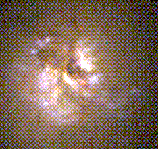
Radio Galaxy Cygnus A (photo by HST, NASA), a powerful radio type II radio source 700 million light-years from Earth.
A radio galaxy is a galaxy that emits radio waves.
Active galactic nuclei
Active galactic nuclei are galaxies that have a massive black hole at the galactic center (nucleus). These galaxies produce huge amounts of energy (at all wavelengths of the electromagnetic spectrum); they produce more energy than the total energy emitted from each of the stars in the nebula.