
|
| Table of Contents | Enchanted Learning All About Astronomy |
Site Index |
| Our Solar System | Stars | Glossary | Printables, Worksheets, and Activities | ||||||
| The Sun | The Planets | The Moon | Asteroids | Kuiper Belt | Comets | Meteors | Astronomers | ||
| THE SUN |
| Introduction to the Sun | Solar Structure | Size, Mass | Flares, |
Sun's Birth | Solar Eclipses | Activities, Web Links |
|---|---|---|---|---|---|---|
| Solar Rotation | Sunspots | Sun's Death |
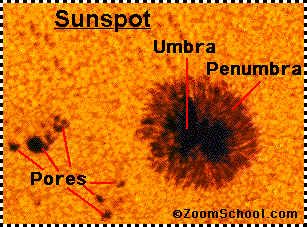
 Sunspots are relatively cool, dark patches on the sun's surface. They come in many shapes and sizes; they often appear in groups. These spots are much bigger than the Earth; they can be over 10 times the diameter of the Earths.
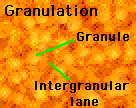 Granulation is solar granules together with intergranular lanes (dark, cool areas between granules where solar material is descending into the surface). Granulation covers the visible surface (the photosphere) of the Sun.
GRANULES:
Granules are regions of the sun where hot solar material comes to the solar surface. Granules are about 600 miles (1,000 km) across and only exist for about 5 to 10 minutes before they fade away. It is almost as though the surface of the Sun is bubbling like a pot of boiling water.
What Causes Sunspots?
Sunspots occur where the sun's magnetic field loops up out of the solar surface and cool it slightly, making that section less bright. These disturbances in the sun's magnetic field make the sunspot about 2700°F (1500°C) cooler than the surrounding area.
Enchanted Learning®
Over 35,000 Web Pages
Sample Pages for Prospective Subscribers, or click below
|
Overview of Site What's New Enchanted Learning Home Monthly Activity Calendar Books to Print Site Index K-3 Crafts K-3 Themes Little Explorers Picture dictionary PreK/K Activities Rebus Rhymes Stories Writing Cloze Activities Essay Topics Newspaper Writing Activities Parts of Speech Fiction The Test of Time
|
Biology Animal Printouts Biology Label Printouts Biomes Birds Butterflies Dinosaurs Food Chain Human Anatomy Mammals Plants Rainforests Sharks Whales Physical Sciences: K-12 Astronomy The Earth Geology Hurricanes Landforms Oceans Tsunami Volcano |
Languages Dutch French German Italian Japanese (Romaji) Portuguese Spanish Swedish Geography/History Explorers Flags Geography Inventors US History Other Topics Art and Artists Calendars College Finder Crafts Graphic Organizers Label Me! Printouts Math Music Word Wheels |
Click to read our Privacy Policy
| Search the Enchanted Learning website for: |