Zoobooks magazine for kids!
Advertisement.

EnchantedLearning.com is a user-supported site.
As a bonus, site members have access to a banner-ad-free version of the site, with print-friendly pages.
Click here to learn more.

Become a member of Enchanted Learning.
Site subscriptions last 12 months.
Click here for more information on site membership.

$20.00/year or other amount
(directly by Credit Card)

$20.00/year or other amount
(via PayPal)

$20.00/year or other amount
(for sending a check by mail)

$20.00/year or other amount
(for subscribing by school purchase order)
As a thank-you bonus, site members have access to a banner-ad-free version of the site, with print-friendly pages.
(Already a member? Click here.)

More about Iguanodon
Dinosaur Printouts
AllAboutDinosaurs.com
Iguanodon
Animal Printouts


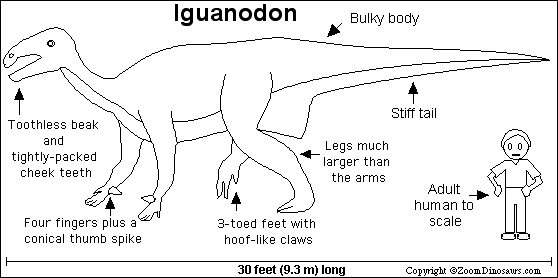
Iguanodon was a plant-eating dinosaur that had a conical spike on each thumb. This 30-foot-long dinosaur lived during the early Cretaceous period, about 135 to 125 million years ago and may have lived in herds. Iguanodon was the second dinosaur discovered.

Anatomy: Iguanodon was a dinosaur that had a horny, toothless beak and tightly-packed cheek teeth. On each hand, Iguanodon had four fingers plus a conical thumb spike on each hand (that was perpendicular to the other fingers). The thumb spikes may have been used for defense or in obtaining food. Iguanodon had a flat, stiff tail and three-toed hind feet with hoof-like claws. Its legs were much larger than its arms.

Fossils and Name: Iguanodon was named by Gideon A. Mantell in 1825. Mantell recognized the similarity between Iguanodon's tooth and that of the modern iguana, except the Iguanodon's was much larger. Iguanodon was the second dinosaur fossil named, and Mantell named it Iguanodon, meaning "iguana tooth." Hundreds of Iguanodon fossils have been found around the world, especially in Belgium, England, Germany, North Africa, and the USA. The type species, I. anglicum, was named by Holl in 1829.


Enchanted Learning Search

First search engine with spelling correction and pictures!
Search EnchantedLearning.com for all the words:
Enter one or more words, or a short phrase.
You can use an asterisk * as a wild-card.


Advertisement.


Advertisement.


Copyright ©2000-2008 EnchantedLearning.com ------ How to cite a web page