Advertisement.
EnchantedLearning.com is a user-supported site.
As a bonus, site members have access to a banner-ad-free version of the site, with print-friendly pages.
Click here to learn more.
(Already a member? Click here.)
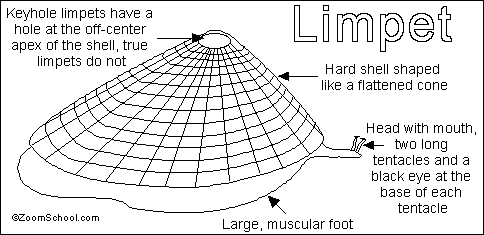
The limpet is a gastropod, a soft-bodied invertebrate (an animal without a backbone) that is protected by a very hard, flattened conical shell. This mollusk is found in cooler waters of the Atlantic Ocean and the Pacific Ocean. Limpets cling tightly to a rock (using the muscular foot). During the day, limpets move around by rippling the muscles of the foot in a wave-like fashion, looking for food. They return to the same place on their rock each night. No one knows exactly how they find their way back to the same spot each time.
Diet: Limpets are herbivores (plant-eaters) that eat during the day. They eat marine algae and other marine vegetation. Limpets eat using a radula, a rough tongue-like organ that has thousands of tiny denticles (tooth-like protrusions).
Anatomy: The soft body is divided into the head, the visceral mass, and the foot (which is small). The limpet has a long pair of tentacles on the head; it has a light-sensitive eyespot located on the base of each tentacle. The biggest limpets are up to 4 inches (10 cm) wide, but most are smaller. The limpet's shell is not coiled.
Predators: Many fish, starfish, birds, and people eat limpets.
Enchanted Learning Search
|
Search the Enchanted Learning website for:
|
Advertisement.
Advertisement.
Copyright ©2000 EnchantedLearning.com ------ How to cite a web page
