

Advertisement.

EnchantedLearning.com is a user-supported site.
As a bonus, site members have access to a banner-ad-free version of the site, with print-friendly pages.
Click here to learn more.

Join Enchanted Learning
Site subscriptions last 12 months.
Click here for more information on site membership.

As low as $20.00/year (directly by Credit Card)

Site members have access to the entire website with print-friendly pages and no ads.
(Already a member? Click here.)

ZoomDinosaurs.com
Dinosaur and Paleontology Dictionary
A B C D E F G H I J K L M N O P Q R S T U V W X Y Z

Click on an underlined word for more information on that subject.
If the dinosaur or paleontology term you are looking for is not in the dictionary, please e-mail us.

EQ - Encephalization Quotient

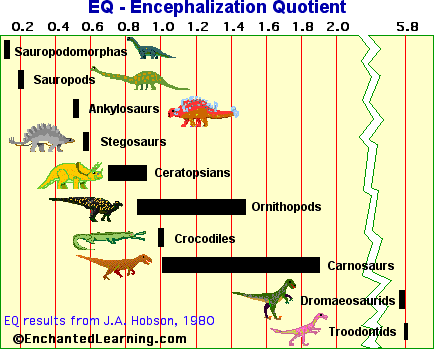
The EQ or Encephalization Quotient is a simple way of measuring an animal's intelligence. EQ is the ratio of the brain weight of the animal to the brain weight of a "typical" animal of the same body weight.

Assuming that smarter animals have larger brains to body ratios than less intelligent ones, this helps determine the relative intelligence of extinct animals. In general, warm-blooded animals (like mammals and birds) have a higher EQ than cold-blooded ones (like amphibians, reptiles and bony fish). Birds and mammals have brains that are about 10 times bigger than those of bony fish, amphibians, and reptiles of the same body size.

The primitive dinosaurs belonging to the group sauropodomorpha (which included Massospondylus, Riojasaurus, and others) were among the least intelligent of the dinosaurs, with an EQ of about 0.05. The troodontids (including Troodon) and dromaeosaurid dinosaurs (the "raptors," which included Dromeosaurus, Velociraptor, Deinonychus, and others) had the highest EQ among the dinosaurs, about 5.8.
EQ


The Encephalization Quotient (EQ) was developed by the psychologist Harry J. Jerison in the 1970's. James A. Hopson (a paleontologist from the University of Chicago) did further development of the EQ concept using brain casts of many dinosaurs. Hopson found that theropods (especially Troodontids) had higher EQ's than plant-eating dinosaurs. The lowest EQ's belonged to sauropods, ankylosaurs, and stegosaurids.

Reference: Hopson, J. A. 1980, Relative brain size in dinosaurs - implications for dinosaurian endothermy, pp. 287-310 , American Association for the Advancement of Science Symposium no. 28.


Enchanted Learning®
Over 20,000 Web Pages.
Sample Pages for Prospective Subscribers

Overview of Site
What's New
Enchanted Learning Home
Monthly Activity Calendar
Books to Print
Site Index

K-3
Crafts
K-3 Themes
Little Explorers
Picture dictionary
PreK/K Activities
Rebus Rhymes
Stories
Writing
Cloze Activities
Essay Topics
Newspaper
Writing Activities
Parts of Speech

Fiction
The Test of Time
Biology
Animal Printouts
Biology Label Printouts
Biomes
Birds
Butterflies
Dinosaurs
Food Chain
Human Anatomy
Mammals
Plants
Rainforests
Sharks
Whales
Physical Sciences
Astronomy
The Earth
Geology
Hurricane
Landforms
Oceans
Tsunami
Volcano
Languages
Dutch
French
German
Italian
Japanese (Romaji)
Portuguese
Spanish
Swedish
Geography/History
Explorers
Flags
Geography
Inventors
US History

Other Topics
Art and Artists
Calendars
Crafts
Graphic Organizers
Label Me! Printouts
Math
Music

Click to read our Privacy Policy

E-mail


Enchanted Learning Search

First search engine with spelling correction and pictures!
Search EnchantedLearning.com for all the words:
Enter one or more words, or a short phrase.
You can use an asterisk * as a wild-card.


Advertisement.


Advertisement.


Copyright ©1996-2008 EnchantedLearning.com ------ How to cite a web page