Advertisement.

EnchantedLearning.com is a user-supported site.
As a bonus, site members have access to a banner-ad-free version of the site, with print-friendly pages.
Click here to learn more.

Become a member of Enchanted Learning.
Site subscriptions last 12 months.
Click here for more information on site membership.

$20.00/year or other amount
(directly by Credit Card)

$20.00/year or other amount
(via PayPal)

$20.00/year or other amount
(for sending a check by mail)

$20.00/year or other amount
(for subscribing by school purchase order)
As a thank-you bonus, site members have access to a banner-ad-free version of the site, with print-friendly pages.
(Already a member? Click here.)

ZoomDinosaurs.com EnchantedLearning.com
Ichthyosaurus
Animal Printouts
Label Me! Printouts

(pronounced IK-thee-oh-SAWR-us) Ichthyosaurus was an ichthyosaur, a marine reptile; it was not a dinosaur. This sleek animal could perhaps swim at speeds up to 25 mph (40 kph). Ichthyosaurus lived from the early Jurassic period until the early Cretaceous period, roughly 206 to 140 million years ago.

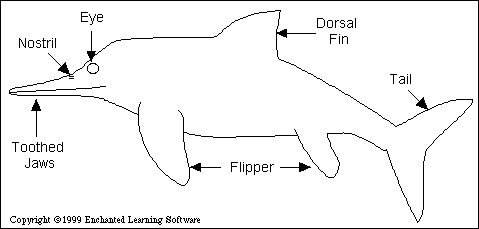
Anatomy: Ichthyosaurus was about 6.5 feet (2 m) long and ay have weighed about 200 pounds (90 kg). It had a tall dorsal fin, a half-moon-shaped tail, paddle-like flippers, and smooth skin. The nostrils were near the eyes on the top of the head. It had massive ear bones and large eyes, probably indicating that it had acute hearing and keen eyesight. These marine reptiles gave birth to live young.

Diet: Ichthyosaurus' diet was mostly fish, but may have also included cephalopods (like straight-shelled belemnites).

Fossils: Hundreds of Ichthyosaurus fossils have been found in England, Germany, Greenland, and Alberta, Canada. Even fossilized dung (called coprolites) and fossilized skin impressions have been found. Ichthyosaurus, which means "fish lizard," was named by Charles Koenig in 1818.


Enchanted Learning Search

First search engine with spelling correction and pictures!
Search EnchantedLearning.com for all the words:
Enter one or more words, or a short phrase.
You can use an asterisk * as a wild-card.


Advertisement.


Advertisement.


Copyright ©1999-2008 EnchantedLearning.com ------ How to cite a web page