Zoobooks magazine for kids!
Advertisement.

EnchantedLearning.com is a user-supported site.
As a bonus, site members have access to a banner-ad-free version of the site, with print-friendly pages.
Click here to learn more.

Become a member of Enchanted Learning.
Site subscriptions last 12 months.
Click here for more information on site membership.
$20.00/year or other amount
(directly by Credit Card)
$20.00/year or other amount
(via PayPal)
$20.00/year or other amount
(for sending a check by mail)
$20.00/year or other amount
(for subscribing by school purchase order)
As a thank-you bonus, site members have access to a banner-ad-free version of the site, with print-friendly pages.
(Already a member? Click here.)

More Dinosaur Fact Sheets EnchantedLearning.com
Spinosaurus Fact Sheet
Dinosaur/Paleontology Dictionary
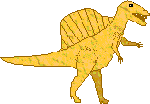
NAME: Meaning - Spinosaurus means "spiny lizard" because it had large bony spines on its back
Pronounced SPINE-o-SAWR-us
Named By - Ernst Stromer von Reichenbach
When Named - 1915
DIET: Carnivore (meat-eater). Spinosaurus probably ate plant-eating dinosaurs and large fish.
SIZE: Length - 40-50 feet (12-15 m) long
Weight - 4 tons or more
WHEN IT LIVED: Middle Cretaceous period, about 97.5-95 million years ago
WHERE IT LIVED: Fossils have been found in Egypt and Morocco, Africa.
FOSSILS: Incomplete fossils have been found, including blade-like neural spines up to 6 feet (1.8 m) long. The original fragmentary fossil specimen from Egypt (found in 1912) was destroyed in World War 2.
CLASSIFICATION:
  • Kingdom Animalia (animals)
  • Phylum Chordata (having a hollow nerve chord ending in a brain)
  • Class Archosauria (diapsids with socket-set teeth, etc.)
  • Order Saurischia - lizard-hipped dinosaurs
  • Suborder Theropoda - bipedal carnivores
  • Tetanura - advanced theropods
  • Family Spinosauria - huge Cretaceous period predators with crocodile-like jaws and neural spines forming a sail.
  • Genus Spinosaurus
  • Species S. aegyptiacus (type species named by Stromer, 1915)
INTERESTING
FACTS:
Spinosaurus' sail may have been for heat dissipation - it lived in a swampy environment near the equator during the warm Cretaceous period. The sail may have also been used to attract mates or seem bigger than it was.


Enchanted Learning Search

First search engine with spelling correction and pictures!
Search EnchantedLearning.com for all the words:
Enter one or more words, or a short phrase.
You can use an asterisk * as a wild-card.


Advertisement.


Advertisement.


Copyright ©2001-2008 EnchantedLearning.com ------ How to cite a web page