
|
| You might also like: | Sea Cucumber Printout | Sand Dollar Printout | Sea Urchin | Echinoderm Printouts | Sea Anemone Printout | Today's featured page: USA Regional Map/Quiz Printouts |
| Echinoderm Printouts | EnchantedLearning.com Brittle Star |
Animal Printouts Label Me! Printouts |
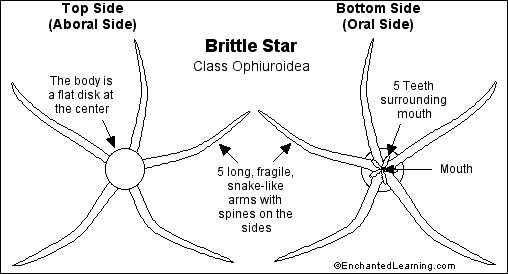
The most common brittle star is the long-armed brittle star (Amphipholis squamata), a gray-blue, luminescent (glowing) species.
Anatomy: Most brittle stars have five (or a multiple of five) long, thin, spiny arms that radiate from a flat central disk; the arms do not touch each other at their bases. Many of the arms are forked. If a brittle star's arm is cut off, it will regenerate (regrow). Brittle stars that have multiple-forked arms are called basket stars.
Most brittle stars are under 1 inch (2.5 cm) in diameter. They have a hard endoskeleton and vary in color. They do not have a brain; they have a simple ring of nerve cells that moves information around the body. Tube feet located along the arms sense light and smells.
Diet: Brittle stars are mainly detrivores (detritus-eaters); they eat decaying matter and plankton. Some brittle stars can also kill small animals. They push their stomach out through their mouth (which is located on the underside of the disk of the brittle stars) and digest the prey (there is no anus). The mouth has five teeth.
Classification: Kingdom Animalia (animals), Phylum Echinodermata (echinoderms), Class Ophiuroidea (brittle stars and basket stars).
| Search the Enchanted Learning website for: |