|
 |
Zoom Dinosaurs DINOSAUR QUESTIONS |
 |
| Current Questions | Top 16 Questions | Old Questions | Ask A Question For Site Supporters Only |
||||
| By Date | By Type of Dinosaur | General Dino. Qns. | Qns. About Other Animals | Geological Era Qns. | |||
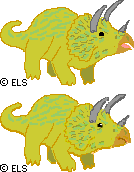
A: For information on Stygimoloch, click here.
A: It's in Indiana. For a map, click here.
A: Deinonychus weighed up to about 175 pounds (80 kg). For more information on Deinonychus, click here.
A: Richard Owen.
A: Amphicyon was up to about 6.6 ft (2 m) long.
A: The oldest-known fossil is that of blue-green algae (single-celled organisms), which date from the Archeozoic Eon, 3.9 to 2.5 billion years ago.
A: The American paleontologist Othniel C. Marsh described and named Apatosaurus in 1877. A few years later, in 1879, he described and named another fossil, Brontosaurus. It turned out that the two dinosaurs were actually two species of the same genus. The earlier scientific name, Apatosaurus, was adopted.
For more information on Brontosaurus/Apatosaurus, click ehre
A: For a section on T. rex's diet, click here.
A: Diplodocus went extinct about 145 million years ago (during the late Jurassic period) during a minor mass extinction - no one knows the cause of this extinction. For information on Diplodocus, click here.
A: It's virtually impossible to tell from the fossil remains. Some people think that males often had larger crests (or other ornamental structures), but this isn't necessarily so. For a page on this, click here
.
A: The pachycephalosaurs (thick-skulkled plant-eating dinosaurs that included Pachycephalosaurus, Stegoceras, Homalocephale, etc.), lived during the late Cretaceous period.
A: Pachy means thick, cephalo means head and saur means lizard.
A: Komodo dragons are really lizards (they're the biggest lizard alive today). For information on Komodo Dragons, click here.
A: No, because dinosuar DNA has not been found yet.
A: According to the paleontologist Robert Bakker, Apatosaurus may have had
thick, moose-like lips that would help in gathering plant material. This is not certain, however.
A: T. rex weighd about 5 to 7 tons. For more information on T. rex, click here.
A: Dinosaurs were reptiles and probably evolved into the birds (so they're closely related to birds).
A: It's very difficult to answer vague questions. What type of information do you want on carnivores (meat-eaters)? Are you interested in carnivorous dinosaurs, or all the carnivores that ever lived?
A: T. rex lived during the late Cretaceous period. Fossils have been found in western North America and Mongolia. For more information on T. rex, click here.
A: The ankylosaurs lived dur the latter half of the Mesozoic Era. For more information on the ankylosaurs, click here.
A: Ornitholestes was a small, fast-running, meat-eating dinosaur. For more information on Ornitholestes, click here.
A: Pterosaurs, including Pteranodon and Pterodactylus.
A: T. rex belonged to the order Saurischia. For more information on T. rex's classification, click here.
A: No one is certain. For a page on this debate, click here.
A: T. rex was a carnivore, a meat-eater. It ate other large dinosaurs, like Triceratops (whose bones fragments have been found in fossilized T. rex feces). For more information on T. rex's diet, click here.
A: Giganotosaurus was 47 feet long. For more information on Giganotosaurus, click here.
A: No.
A: During the Triassic period, roughly 130 million years ago..
A: During the Ordovician Period (505 to 438 million years ago), the first vertebrates (jawless fish), the first corals, and the first land plants appeared.
A: Staurikosaurus walked on 2 legs and weighed roughly 50-100 pounds (20-40 kg). It was a fast runner; that was probably its best defense. For information on Staurikosaurus, click here.
A: Click here.
A: They died out about 65 million years ago during the K-T extinction.
A: The oldest-known dinosaur fossil is about 230 million yeasr old.
A: Most paleontologists think T. rex was an active predator but there is a minority viewpoint that it was mostly a scavenger. For more information on this debate, click here.
A: For information on dinosaur diets, click here.
A: For a page on early mammals, click here.
A: For that information on Stegosaurus, click here.
A: For information on Elasmosaurus, click here.
A: Spinosaurus went extinct about 95 million years ago. For information on Spinosaurus, click here.
A: No one knows. For information on Spinosaurus, click here.
A: Carnosaurus (it is a nomen nudum (published without a proper or complete description); Carnosaurus is not a recognized dinosaur genus.
A: For information on Protoceratops, click here.
A: T. rex had 50-60 sharp conical teeth. For more information on T. rex, click here.
A: Brontosaurus (now called Apatosaurus) was an herbivore (a plant-eater). Apatosaurs' main food was probably conifers, which were the dominant plant when the large sauropods lived. Secondary food sources may have included gingkos, seed ferns, cycads, bennettitaleans, ferns, club mosses, and horsetails.
For more information on Apatosaurus, click here.
A: No, but the large marine reptie Tylosaurus was found in New Zealand.
A: Iguanodon had a conical spike on each thumb. For more information on Iguanodon, click here.
A: Plesiadapis lived long before the last Ice Age. For information on Plesiadapis, click here.
A: It's in the dinosaur dictionary - click here for the entry.
A: Pteranodon was a carnivore (flesh-eater) that ate fish
(which they caught at the surface of the oceans), mollusks, crabs, insects,
and scavenged dead animals on land. For more information on Pteranodon, click here.
A: For a list of dinosaurs found in Texas, click here. Great dinosaur trackways were found in Dinosaur Valley State Park in Glen Rose, Texas.
A: Click here.
A: Dimetrodon had sharp teeth and clawed feet.
A: Dimetrodon was at the top of its local food chain. For reasons for the dinosaur's extinction, click here (or see the faq above).
A: The Triassic period was hotter than it is now, with very little seasonality (there was not much difference between the seasons). Since the continents were jammed together into a single supercontinent (called Pangaea), most of the land was desert-like.
A: Click here for late Triassic dinosaurs. For the other period, click on the links at the top of that page.
A: For our page on Parasaurolophus, click here.
A: T. rex lived about 65 million years ago. For pictures and information on T. rex, click here.
A: For a ridiculously short answer, jawless fish were the earliest vertebrates. Some fleshy-lobed bony fish evolved into amphibians (spending part of their llife-cycle on land). Some evolved into reptiles (which breathe with lungs). Dinosaurs (a type of reptile) evolved during the Triassic period.
A: Pterodactylus was a carnivore (a flesh-eater); fish may have been a mainstay in its diet. For more information on Pterodactylus, click here.
A: Greek and Latin roots are the most common. For some commonly-used roots used for dinosaur names, click here.
A: There are about 1,000 known genera and many more species, but these represent only a small percent of the dinosaurs that existed.
A: Yes, if birds indeed evolved from dinosaurs.
A: They had included too many vertebrae in their Kronosaurus.
A: 1. Insects, fish, reptiles (including dinosaurs, plesiosaurs, mosasaurs, crocodilians, nothosaurs, ichthyosaurs, pterosaurs, etc) and many other major animal groups lived during the Mesozoic Era. Three major events during the Mesozoic Era were the evolution of dinosaurs, mammals, and birds. The Mesozoic Era began 248 million years ago and ended 65 million years ago.
A: For information on the moa, click here. Other recently extinct animals include the dodo, dinornis, Ekaltadeta, quagga, and Tasmanian Tiger (probably extinct).
A: The woolly mammoth weighed about 3 tons (2.75 tonnes). For more information on the woolly mammoth (and other mammoths), click here.
A: Iguanodon was named and studied by Gideon A. Mantell in 1825.
A: I'm not sure what you mean. Brachiosaurus was a huge, long-necked plant-eating dinosaur that belonged to a group called sauropods, a type of saurischian (lizard-hipped) dinosaur. The type species for this genus is B. altithorax (Riggs, 1903). For more information on Brachiosaurus, click here.
A: Theordor Roosevelt.
A: 65 million years ago, during the K-T mass extinction.
A: Rex means king.
A: No T. rex eggs have been found yet.
A: Apatodon is a doubtful genus; it is probably the same genus as Allosaurus.
A: No one knows.
A: Agilisarus lived during the middle Jurassic period, about 170 million years ago. A nearly complete skeleton was found in China. For more information on Agilisarus, click here.
A: Dinosaur poop is not called coprolites; only fosilized dinosaur poop is called coprolites. Copro means "dung" (from the Greek word kopros). The ending "-lite" is a common ending for fossil or mineral terms, coming from the Greek word lithos, which means stone. The term coprolite was coined around 1830-1830.
A: T. rex lived in a humid, semi-tropical environment, in open forests with nearby rivers. For more information on T. rex, click here.
A: That was the first time rainfall was caused by cloud seeding (a process in which rain is caused to fall by dropping lots of tiny particles of dry ice into clouds from an airplane; these tiny particles act as nuclei around which rain droplets form).
A: Many new animal species are discovered each year. The Chacaon peccary is an aimal that was discovered in 1972. This pig-like mammal (it is related to the collared peccary) lives in dense scrub in Paraguay, South America (but not in the water). It is an endangered species.
A: The type species of Liopleurodon (L. ferox, Sauvage 1873 ) was estimated to be 12 - 15 meters (39-50 ft) long (L. ferox is the largest-known species of the genus Liopleurodon). Most Liopleurodon fossils are in that size range. For a good page on pesiosaurs, see the entry on Liopleurodon at: http://www.isgs.uiuc.edu/dinos/dml/names/ples.html. All of my reference books cite the smaller size (which we cite), since most known specimen are in that size range (for example, see the Simon and Schuster Encyclopedia of Dinosaurs and other Prehistoric Creatures, 1999, gives Liopleurodon's length as 39 ft = 12m). Note: since no complete fossils of Liopleurodon have been found, Liopleurodon's size is only an estimate (only isolated vertebrae backbones, jaw parts, and teeth are known). I can't find a single source (other than that TV show or those using that show as a primary reference) of a Liopleurodon 80 feet long (Leslie Noe was reportedly working on a really huge pliosaur, possibly Liopleurodon, in the late 1990's in England - perhaps this is what Walking with Dinosaurs was referencing). There's a long history of overestimating the size of prehistoric animals (especiallly pliosaurs) so our site tends to be conservative regarding size estimates. There's a famous Kronosaurus (another large plesiosaur) from Harvard University whose size was grossly overestimated for years (extra vertebrae were inadvertently added); only recently has its size been changed to be more in line with other known specimen of that genus (it went from 50 to 30 feet long). For another good page on pliosaur size (and examples of size overestimation), see: http://www.dinosauria.com/dispatches/19981108001.html
A: Sauropods were an an infraorder of quadrupedal, plant-eating saurischian dinosaurs. They had very long necks, small heads with blunt teeth, a small brain, and long tails for
counterbalancing their necks. They had large guts, which were necessary for digesting huge amounts of plant material. They walked on four short, thick, five-toed legs. For more information on Sauropods, click here.
A: Dinosaurs lived during the Mesozoic Era, from about 230 million years ago until 65 million years ago.
A: ALl of our information on the Triassic period is online. For general information o the Triassic period, click here. For printouts of Triassic animals, click here.
A: There's a huge difference between Lystrosaurus and Mesosaurus. Mesosaurus was one of the first aquatic reptiles; it lived during the Permian period. Lystrosaurus was a heavily-built, quadrupedal, early Triassic period land animal (a dicynodont, a mammal-like reptile).
A: When a scientist discovers a new type of dinosaur, that scientist gives the dinosaur a name. The name can't be right or wrong, it's just a name. For example, when a three-horned dinosaur was found, the scientist Othniel Marsh named it Triceratops (which means three-horned head). He could have given it another name, but the decision was essentially his. For more information on naming, dinosaurs, click here.
A: For information on Brontosaurus (now called Apatosaurus), click here.
A: The smell from feces is the decaying organic matter. In coprolites (fossilized feces), the organic materials have been replaced by rock-like minerals (which don't smell).
A: Minerals are identified by their color, their streak (the color they leave when rubbed against a hard substance), their hardness (using the Moh's scale), their density (called specific gravity), their crystalline structure, and their refractive index (if transparent, how they bend light).
A: No, coprolites are fossilized dung, but if the question were, "Did dinosaurs use dung to mark their territory?" the answers is: no one knows.
A: They vary in age. You can date these fossils by looking at index fossils in the same layer in which they were found or by radioisotope dating the surrounding lava layers.
A: Coprolites, like other fossils, contain rock-like minerals containing calcium, silicon, iron, etc. Iridium is a very rare element found near the center of the Earth, in some asteroids, and in some unusual sedimentary layers of the Earth (like the K-T layer, during which a large asteroid probably hit the Earth, scattering iriduim). Iridium would probably not be found in coprilites.
A: It isn't known with any certainly, but possible predators of Stegosaurus include all the large meat-eaters from western North America during the late Jurassic Period, about 156-140 million yeas ago (where and when Stegoaurus lived). Some of these meat-eaters included Allosaurus, Ceratosaurus, Marshosaurus, Torvosaurus, and maybe even packs of smaller meat-eaters like Ornitholestes. For more information on Stegosaurus, click here.
A: The coprilite of a meat-eater could conceiveably contain the DNA of its victim (For example, a T. rex coprolite was found containing fragments of Triceratops frill, which may in the future be used to obtain Triceratops DNA). Unfortunately, there is no way to reconstruct DNA from fossils yet.
A: The standard answer is that without predators, prey species would over-reproduce and some would starve anyway.
A: All insects have six legs. Arachnids (like spiders, ticks, and scorpions) and octopi have eight legs.
A: When you examing the contents of the coprolite, you will find different things. The dung of a carnivore (meat-eater) may contain bits of bone fragments, hair, etc. For example, a T. rex coprolite was found containing fragments of Triceratops frill. The dung of an herbivore (plant-eater) will contain undigested bits of plants. An omnivore's dung will contain both.
A: No one knows how Herrerasaurus reproduced except that they probably hatched from eggs.
A:
 Dinosaur legs: upright position |
 Other reptiles: Sprawling legs |
A: The dinosaurs were reptiles and did not have an advanced social structure with a leader or king. An individual herd or pack of dinosaurs may have had a big, physically dominating individual.
A: Yes. Since most of the molecules in the dung are replaced by rock-like minerals, the color changes.
A: Dinosaur poop is not called coprolites; only fosilized dinosaur poop is called coprolites. Copro means "dung" (from the Greek word kopros). The ending "-lite" is a common ending for fossil or mineral terms, coming from the Greek word lithos, which means stone. The term coprolite was coined around 1830-1830.
A: Yes, because they dry out.
A: 1. No, coprolites cannot be used as fossil fuel. Coprolites are fossilized dung. Although dung burns, when it fossilizes, most of its original molecules are replaced by rock-like mineral.
2. The same factors that kept any fossilized thing from decaying, including being immediately buried in dry sand, earth, mud, anaerobic water, etc.
A: Click here for a page on Wegener and Pangaea.
A: They're called ichnologists (they also study other trace fossils like footprints, tailprints, and nests), and they study fossilized dung to learn about the diet of the animal it came from.
A: I don't know.
A: Euthecodon is an extinct genus of crocodilian that lived during the Neogene (the middle Miocene, roughly 13-16 million years ago). Fossils have been found in Ombo, Kenya, Africa.
A: The American Museum of Natural History in New York City is a great museum. For more museums with dinosaurs, click here.
A: An adult T. rex weighed about 5 to 7 tons . For more information on T. rex, click here.
A: Probably not.
A: I don't know. It sounds like a good topic of discussion for a dinosaur talk forum, you might want to post at the dinotalk section and see what responses you get.
A: Canaliculi (tiny passages in bone which connect blood vessels to cells) are similar for birds and ornithomimid dinosaurs, but are different in mammals and plant-eating dinosaurs (like Triceratops and duck-billed dinosaurs); in these, they were quite different (the canaliculi were jumbled in birds and dinosaurs, but were
radially arranged in mammals). For more information, click here.
A: For information on Dilophosaurus, click here.
A: They're called ichnologists (they also study other trace fossils like footprints, tailprints, and nests), and they study fossilized dung to learn about the diet of the animal it came from.
A: Iguanodon was an ornithischian (bird-hipped) dinosaur. Its fossils have been found in Belgium, England, Germany, North Africa, and the USA. For more information on Iguanodon, click here.
A: That questions and answer did not appear in ZoomDinosaurs - you must have seen it on another site - but I do agree with its original answer.
A: Click here for information on Rhamphorhynchus.
A: Most dinosaurs were plant-eaters, including all the sauropods (like Apatosaurus, Diplodocus, and Brachiosaurus) and ornithischians (Like Stegosaurus, Iguanodon, Maiasaura, and Triceratops). For information on dinosaur diets, click here.
A: Brontosaurus (Apatosaurus) was a lizard-hipped (saurischian) dinosaur.
A: For information on Thescelosaurus, click here.
A: Ultrasauros was found in North America.
A: Click here for information on Allosaurus.
A: It's Eudibamus. For more information on it, click here.
A: Because fossilized dung (coprolites) can tell you more about the diet of the dinosaur than just about anything else.
A: Click here for information on Pangaea.
A: It might be in the future, but it isn't a certainty.
A: Yes, click here for all the known dinosaur genera listed in alphabetical order.
A: For information on sabertooth cats, click here
A: Parrosaurus is a dubious genus and is probably a Hypsibema (a duck-billed dinosaur). Only a few bones have been found (and no skull), so no one knows exactly what it looked like. For information on Parrosaurus, click here. For information on Hypsibema, click here.
A: Brontosaurus (Apatosaurus) lived during the Jurassic period. For more information on this Brontosaurus (Apatosaurus), click here.
A: Probably. For more informatin, click here.
A: Ankylosaurus means "Fused, stiff, or bent Lizard." For more information on Ankylosaurus, click here.
A: What type of homework do you want?
A: Most were plant-eaters, some were meat-eaters, a few ate both.. For more information, click here.
A: Tsintaosaurus means "Tsintao lizard", named for the city of Tsingtao (Ch'ing-tao or Qingdao, which means "green island") near where the fossil was found in the Wangshi Formation, Shandong Province, China.
A: Click here.
A: The earliest dinosaurs so far have been found on the island of Madagascar, off the continent of Africa.
A: For information on Alamosaurus, click here.
A: T. rex is the most famous dinosaur.
A: Blod pressure must have varied quite a bit among the different types of dinosaurs. I've only seen estimates of blood pressure on some of the long-necked dinosaurs, like Brachiosaurus, who must have had extremely high blood pressure. For more information, click here.
A: Click here.
A: Brachiosaurus is its scientific name (it is its genus name). For information on Brachiosaurus, click here.
Q: We need as much info on
the Parrosaurus you have!!!!We also need a Picture of a
Parrosaurus
from Nat and Sara,
Salem,
Missouri,
Usa;
November 15, 2000
Q: in geologic time period
did the brontosaurus live?
from JeNnIfEr,
bayside,
ny,
us;
November 15, 2000
Q: Are birds the descendants
of dinasaurs?
from Jikado Z.,
laurel,
MD,
USA;
November 15, 2000
Q: what is the meaning of
Ankylosauros name
from ?,
?,
?,
?;
November 15, 2000
Q: Why do you don't have 1st
and 2nd graders homework?
from L-T,
Mpls,
Mn,
United state;
November 15, 2000
Q: What do dinosaurs
eat?
from ?,
?,
?,
?;
November 15, 2000
Q: what does the name
tsintaosaurus mean?
from alex r,
brooksville,
florida,
u.s.a.;
November 15, 2000
Q: which dinosaurs eat meat
and which dinosaurs eat plants?
please answer my question as soon as possible
or else i will get caught.
please hurry!!!!!!!
from lilliana m,
milwaukee,
w.i.november 15 ,2000,
?;
November 15, 2000
Q: The earliest dinos found
so far were discovered in ?(country) in ?(continent?.
from
Michael L,
Bloomsburg,
Pa,
USA;
November 15, 2000
Q: I am doing a report on
Alamosaurus and I need pictures and infomation on it. Can u give me
some?
from Ashley F,
idonttellpeopleidontno,
NJ,
USA;
November 15, 2000
Q: hello my name is lilliana
m. and i want
to ask you guys which animal is the most famous
from
lilliana m.,
milwaukee,
w.i november 15,2000,
hello;
November 15, 2000
Q: How can we get an
estimate of blood Pressure in dinosaurs.
from Michael L,
Bloomsburg,
Pa,
USA;
November 15, 2000
Q: Do you have a picture on
a wolly mammoth? Or a drawing or something like that? Please tell
me.
from S.D.,
Bellevue,
Washington,
USA;
November 14, 2000
Q: What is the scientific
name of BRACHIOSAURUS?
from Alexandra B.,
cagayan de Oro City,
Misamis Oriental,
Philippines;
November 14, 2000
Q:
A: Click here for an introduction to dinosaurs.
A: Deinosuchus, an enormous crocodilian, lived and died during the late Cretaceous period.
A: Usually, carnivores (meat-eaters) have sharp teeth that are good for tearing flash. Herbivores (plant-eaters) usually have blunter teeth that are good for stripping vegetation from plants.
A: The sabertooth cats lived during the Pleistocene Epoch (the early part of the Quaternary Period). For more information on sabertooth cats, click here.
A: The oldest-known bird is Archaeopteryx, which lived during the Jurassic period, about 150 million yeasr ago. For more information on Archaeopteryx, click here.
A: Four years as an undergraduate and five years in graduate school. The weirdest questions are unquotable online and far off topic.
A: For a page on New Jersey, click here.
A: Stegosaurus went extinct about 140 million years ago. It probably used both its beak and its teeth to strip plants of foliage but it did not chew its food; it swallowed it whole. Although I've never seen any suggestions that Stegosaurus could rear up on its hind legs to get food, looking at its skeletal structure, it may have been able to do so. For more information on Stegosaurus, click here.
A: I've never seen an estimate of Stegosaurus' life span. Nothing is known about Stegosaurus' reproduciton except that it probably hatched from eggs.
A: 90 feet is about 0.0275 km or 27.5 m. Apatosaurus means "Deceptive Lizard". For more information on Apatosaurus, click here.
A: The oldest-known dinosuar date from about 230 million years ago in what is now Madagascar (they haven't been named yet). The second-oldest is Eoraptor, from Argentina.
A: Click here for information on Nodosauurs.
A: I answered this question earlier today - scroll down the page.
A: No.
A: It means "Covered Lizard" or "Roof lizard". For information on Stegosaurus, click here.
A:
Dinosaur legs: upright position |
Other reptiles: Sprawling legs |
A: Probably, although none have been found so far. For information on Giganotosaurus, click here.
A: Ammonites were marine invertebrates (mollusks) that were a bit like the modern-day nautilus. For information on ammonites, click here.
A: All dinosaurs were air-breathing land animals that had lungs. No fossilized dinosaur lungs have been found yet, so thier lung structure is not known.
A: Many dinosaurs were plant-eaters, including the sauropds and ornithischians, like Brachiosaurus and Stegosaurus. The theropods, like T. rex and Velociraptor, were meat-eaters.
A: I've never heard of hypsilodon. For information on Hypsilophodon, click here.
A: No baby T. rex have been found, so their size is unknown. Same for Brachiosaurus. Also, no one knows the life span of T. rex. For information on dinosaurs' life spans, click here.
A: T. rex fossils have been found in the USA (in Montana, Texas, Utah, and Wyoming), Canada
(Alberta and Saskatchewan), and east Asia (Mongolia). For more information on T. rex, click here.
A: Click here for a page on Jurassic period plants.
A: Click here.
A: Brontosaurus (now called Apatosaurus) had teeth shaped like a pencil. For information on Apatosaurus, click here.
A: No one knows for sure that they did care for their young. For information on Triceratops, click here.
A: For a page with North American fossils (including US fossils), click here.
A: 1. Staurikosaurus - this is a genus
2. Lesothosaurus - this is a genus
3. Theropods - this is a a suborder of saurischian dinosaurs containins many genera
4. Ceratosaurs - this is a group of theropods containing many genera (including Ceratosaurus)
5. Allosauridae - a group of theropods containing many genera (including Allosaurus)
6. Tyrannosaurus - this is a genus
7. Struthiomimus - this is a genus
8. Deinonychus - this is a genus
9. Oviraptor - this is a genus
10. Saurornithoides - this is a genus
11. Alxasaurus - this is a genus
12. Riojasaurus - this is a genus
13. Plateosaurus - this is a genus
14. Diplodocus - this is a genus
15. Camarasaurus - this is a genus
16. Heterodontosaurus - this is a genus
17. Hypsilophodon - this is a genus
18. Hypsilophodontid - a group of ornithischians containing many genera
19. Tenontosaurus and Dryosaurus - these are both genera
20. Camptosaurus - this is a genus
21. Iguanodon - this is a genus
22. Ouranosaurus - this is a genus
23. Edmontosaurus - this is a genus
24. Scelidosaurus - this is a genus
25. Scutellosaurus - this is a genus
26. Huayangosaurus - this is a genus
27. Stegosaurus - this is a genus
28. Tuojiangosaurus - this is a genus
29. Kentrosaurus - this is a genus
30. Anklosauria - this is a group of armored dinosaurs containing many genera, like Ankylosaurus
31. Nodosaurus - this is a genus
32. Euoplocephalus - this is a genus
33. Polacanthus - this is a genus
34. Ceratopsian Psittacosaurus - Psittacosaurus is a genus (Ceratopsians are a group of ornithischians containing many genera
35. Protoceratops - this is a genus
36. Triceratops - this is a genus
37. Stegoceras - this is a genus
A: No one knows what color Stegosaurus was (or any of the dinosaurs). Unfortunately, the substances that color a skin (organic pigments) do not remain during the fossilization process.
A: For information on Joseph Leidy, click here.
A: The earliest-known bird (Archaeopteryx) dates from the Jurassic period.
A: For an overview of the Devonian, see the entry in the dinosaur dictionary. For more information, see this page at UCMP.
A: Some fossilized T. rex dung was found containing bone from a Triceratops frill. T. rex probably also ate other dinosaurs. No one is sure exactly what species it ate other that Triceratops.
A: For some insect pictures, click here.
A: Footprints are good evidence as are bonebeds (places where many fossils are found together). For example, there are places where hundreds or thousands of fossils of the same species are found together.
A: The K-T mass extinction occured at the end of the Mesozoic, 65 million years ago.
A: For information on Stegosaurus, click here.
A: Some plant-eaters included Brachiosaurus, Apatosaurus (Brontosaurus), Diplodocus, Stegosaurus, Maiasaura, and Pachycephalosaurus.
A: Avimimus was found in Mongolia by Dr. Sergei Kurzanov. For more information on Avimimus, click here.
A: White
A: About 1000 different groups (genera) of dinosaurs have been found so far. In the US, the most fossils have been found in the west, in states like Montana, Utah, Wyoming, Texas and Colorado. For a list of dinosaur fossils state by state, click here.
A: A healthy, adult Seismosaurus probably had no predators.
A: No one knows.
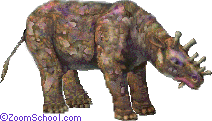 A: For information on Uintatherium, click here.
A: Dinosaurs lived during the Mesozoic Era.
A: A carnivore is a meat-eating organism. T. rex, for example, was a carnivore.
A: Plant-eaters are also called herbivores or primary consumers.
A: For information on Eohippus, the earliest-known horse, click here.
A: Probably not. For information on Megalodon, click here.
A: For dinosaurs listed by location, click here.
A: Styracosaurus was an ornithischian (bird-hipped) dinosaur. For more information on Styracosaurus, click here.
A: About 65 million years ago.
A: birds
A: bipedal
A: Allosaurus was a tetanuran theropod related Altispinax, Becklespinax, Piatnitzkysaurus, Streptospondylus, and Xuanhanosaurus. For more information on Allosaurus, click here.
A: Click here.
A: Click here for a page on dinosaur defenses.
A: Dactyl mean finger.
 A: No, the world looked quite quite a bit different. For more information and pictures of Pangaea, click here.
A: The oldest dinosaur date from about 230 million years ago. The oldest so far (yet unnamed) are from Madagascar. One very old dinosaurs is Eoraptor, which lived in the late Triassic period, roughly 228 million years ago. For information on Eoraptor, click here.
The oldest-known fossil is that of blue-green algae (single-celled organisms), which date from the Archeozoic Eon, 3.9 to 2.5 billion years ago.
A: It's in the dino dictionary - click here.
A: The only esophagus I've ever heard of is the tube from the mouth to the stomach.
A: T. rex's arm bones were about 3 feet (1 m) long.
A: None, but there were other reptiles during the Mesozoic Era (the time of the dinosuars) that swam, including plesiosaurs, nothosaurs, mosasaurs, and ichthyosaurs.
A: Ceratopsians were group (sub-order) of dinosaurs that included dinosaurs like Triceratops, Styracosaurus, Pentaceratops, and Monoclonius. There were other horned dinosaurs, though, including Ceratosaurus, a meat-eater.
A: The earliest-known dinosaurs evolved about 230 million years ago.
A: For information on the Komodo dragon, click here.
A: The troodontids (like Troodon) were probably the smartest.
A: Extinction is when a species dies out. A mass extinction is when many different species die out. For more information on extinctions, click here.
A: Triceratops was an herbivore (a plant eater). It probably ate cycads, palms, and other low-lying
plants with its tough beak. For more information on Triceratops (including where it lived), click here.
A: Brontosaurus (now called Apatosaurus) lived in western North America. Fossils have been found in Colorado, Oklahoma,
Utah, and Wyoming, in the USA.
A: Giganotosaurus is its genus name (its scientific name). For more information on Giganotosaurus, click here.
A: Megalodon was an ancient shark. For more information on Megalodon, click here. Most scientists think that it would have been seen it were still alive.
A: You live in a great area for dinosaurs. On our dinosaur museum page, we have two listings for Connecticut, including: Dinosaur State Park [400 West Street , Rocky Hill, CT, see fossilized dinosaur footprints (trackways of Eubrontes). Park Phone: 860-529-8423], and the Peabody Museum in New Haven, CT.
A: Click here.
A: Apatosaurus' main food was probably conifers, which were the dominant plant when the large sauropods lived. Secondary food sources may have
included gingkos, seed ferns, cycads, bennettitaleans, ferns, club mosses, and horsetails. For more information on Apatosaurus, click here.
A: My name is listed above.
A: Deinocheirus (meaning "terrible hand") had the biggest claw. It was a bipedal carnivore (meat-eater) from the late
Cretaceous period. It is classified as a saurischian (lizard-hipped dinosaurs), a theropod, a coelurosaur, and an
ornithomimid (bird mimic). Only the arms, hands, and claws of Deinocheirus have been found (in the Gobi desert
of Mongolia in 1965). The arms are 8 feet (2.4 m) long and have three fingers with long, hook-like claws, 8-12
inches (20-30 cm) long. The hands alone were 2 feet (60 cm) long. Deinocheirus was probably one of the most
deadly dinosaurs of the late Cretaceous period. It may have been larger that T. rex.
A: Some non-dinosaurs that lived during the Cretateous period include Ichthyornis, Ichthyosaurus, Kronosaurus, Pteranodon, etc.
A: Sponges, corals, worms, fish (including early sharks), cephalopods, insects (and many other invertebrates) amphibians, reptiles (including dinosaurs), early mammals, and early birds lived during the Mesozoic Era.
A: Click here.
A: It takes more than two minutes to download mail, read it, write an answer, and upload it to the site.
For information on Gallimimus,
Velociraptor, and tyrannosaurus, click on their names.
A: Yes, quadrupedal carnivores from the Mesozoic Era included some early mammals and many reptiles (like crocodylians, lepidosaurs, turtles, and lizards).
A: For the first dinosaur discoveries, click here.
A: Only fossilized Parasaurolophus skeletons have been found. Since neither eggs nor nests of these dinosaurs have been found, nothing is known about how they reproduced (but they probably hatched from eggs).
A: Oysters eat floating algae, which they filter through their gills. For more information on oysters, click here.
A: I went to school for a ridiculously long time, love science, have a very good reference library, and also use the Web.
A: For information on Pachycephalosaurus, click here.
A: I don't know. If anyone out there knows, please write this page and I'll post it.
A: It probably didn't have any predators - it was very fast and could inflict a good deal of harm if threatened.
A: It if's true that most of the dinosaurs were cold-blooded, then they were mostly diurnal (most active during the day). This would make it easier for the mammals to be nocturnal (most active at night), when dinosaurs wouldn't be chasing them and eating them. Also, many of the early mammals seem to have had large eyes, and most mammals with large eyes are nocturnal.
A: No, there were plenty of other animals and plants alive during the time of the dinosaurs, including mammals, birds, insects, fish, worms, crustaceans, corals, sponges, etc.
A: The K-T bondary is the layer between Cretaceous period rock and Tertiary period rock. It dates from about 65 million years ago, during the K-T extinction. A lot of things are found there (including many fossils), but the most unusual thing found there is a superabundance of the element iridium (which is rare on the Earth's crust) and shocked quartz (which can results from a meteor impact). Iridium is abundant on meteors (and toward the center of the Earth).
A: Birds are the closest living relatives to dinosaurs (and the most similar). Being endothermic (generating their own body heat, or hot-blooded, like mammals and birds) has disadvantages include the need to eat a tremendous amount of food in order to maintain a relatively constant body temperature, and there is a lower-bound to size (the smallest have extremely high metabolic rates). Advantages of ectothermy (not generating their own body heat, or hot-blooded, like amphibians and lizards) include have to spend a lot less time finding and eating food, and they can wait out times of bad weather (extreme hot or cold). The esophagus is the tube to the stomach (some work using peristalsis).
A: Click here.
A: I just answered that yesterday or the day before; scroll down and read!
A: They often leave large craters.
A: Some were, some weren't, and it's unknown for mot dinosaurs. Maiasaura, for example, was a good parent.
A: When the climate changes, the plants in an area change (plants that cannot live in the new climate die, and new plants take over). Animals that ate the old plants cannot necessarily eat the new plants, and they have to either move or die. The predators who ate that type of animal are then affected, and either have to find new prey, move, or die.
A: Click here for Silvisaurus.
A: There are two dinosaurs called Gertie. One is the first animated dinosaur, the other is the nickname of a Chindesaurus fossil found in 1984 in Arizona. For information on them, click here.
A: Because it is the earliest-known bird. For information on Archaeopteryx, click here.
A: T. rex was at the top of the food web - it had no predators. Stegosaurus' predators can only be guessed; for large meat-eaters that lived when it lived (during the late Jurassic period, 156-140 million years ago) and where it lived (western North America, Madagascar, South Africa, Isle of Wight, Southern India, and Mongolia), see this page and look for large meat-eaters that lived in the right places and right times.
For more information on T. rex, click here. For more information on Stegosaurus, click here.
A: Click here.
A: It was discovered by Ruben Carolini in 1994. For information on Giganotosaurus, click here.
A: Ouranosaurus.
A: Sue.
A: For information on Velociraptor, click here.
A: The paleontologist Robert Bakker has suggesed that the huge number of dinosaurs who ate low-growing plants during the acretaceous perios put enormous evolutionary pressure on plants to reproduce quickly. This favored flowering plants (over the conifers which had previously been the dominant flora).
A: No one knows how it reproduced. It went extinct during a minor mass extinction during the late Jurassic period, about 145 million years ago. For a page on Camptosaurus, click here.
A: I don't know what your favortie dinosaur is, but there are lots that start with "S," including Stegosaurus, Styracosaurus, Seismosaurus, Supersaurus, Syntarsus, Scipionyx, Sauropelta, etc.
A: There were a lot of early horses, including the earliest, the tiny Eohippus (also called Hyracotherium).
A: Jawless fish (Agnatha like lampreys and hagfish) do not have a hinged jaw, paired fins, or a bony skeleton (their skeleton is made from cartilage) ; they were the earliest vertebrates to evolve (and the first fish). Cartilaginous fish (Elasmobranchs like sharks, skates, and rays) also do not have a bony skeleton (their skeleton is also made from cartilage), but do have a hinged jaw and paired fins (making them more stable). For more on fish classification, click here.
A: See this page by Glen J. Kuban .
A: They lived during the Mesozoic Era.
A: I have no idea.
A: Birds probably evolved from the dinosaurs.
Dinosaurs and mammals evolved around the same time (during the Triassic period, roughly 220-230 million years ago), but the earliest mammals were not marsupials (marsupials evolved during the Cretaceous period, toward the end of the time of the dinosaurs). Mammals were not that prevalent during the time of the dinosaurs; when the dinosaurs went extinct (about 65 million years ago), the mammals (including the marsupials) became more diversified and more abundant.
A: Kronosaurus was a plesiosaur (a marine reptile) that lived millions of years ago. For more information on Kronosaurus, click here.
A: It means that a species may be heading towards extinction. That species death rate is higher than its reproductive rate, so its population numbers are decreasing. For a page on some endangered animal species, click here.
A: Only a few have been found; two recent ones include Scipionyx and a Thescelosaurus.
A: For a page on dinosaur evolution, click here.
A: The dinosaurs lived during the Mesozoic Era. They lived from about 230 to 65 million years ago.
A: Stegosaurus lived during the Jurassic period, from about 156-140 million years ago. For more information on Stegosaurus, click here.
A: Brontosaurus (now called Apatosaurus) was about 70-90 feet (21-27 m) long.
A: The other type of dinosaurs are lizard-hipped (saurischians). I don't know the relative percentage, plus it would vary on what time period you were looking at, if you were looking at the percentage of individuals (which is not known), or the percent of known genera or species.
A: Barnum Brown found the first T. rex fossils in 1902. For more information on T. rex fossils, click here.
A: T. rex weighd about 5 to 7 tons. For more information on T. rex, click here.
A: The oldest-known fossils are Blue-green algae, archaeans, and bacteria that date from the Archeozoic Eon (Archean), about 3.9 to 2.5 billion years ago. For more information, click here and scroll to near the bottom of the page.
A: Fossilized skin impressions have only been found for a small fraction of the known dinosaurs. Not much is known about dinosaur skin and there are plenty of debates among paleontologists about this topic. Most show bumpy skin, not scaly skin; only the huge plant-eaters seem to have had scaly skin. T. rex had bumpy skin, and ankylosaurs had leathery skin. For a page on dinosaur skin, click here. Also see an interesting page on dinosaur skin from dinosauria.
A: For a page on the earliest-known fossils, click here.
A: For information on T. rex, click here.
Q: What is a glosseaparus? Is it a
dinasour?
from erik,
noblesville,
in,
usa;
November 1, 2000
A: Glossopteris was an ancient plant. For more information on glossopteris, click here.
A: I have no idea. Why don't you ask him (he aso posts in the Cool Dinos Dino Talk section)?
A: Ichthyosaurus was named by Charles Koenig in 1818.. For more information on Ichthyosaurus, click here.
A: Deinonychus was about 10 feet long (3 m), 5 feet tall (1.5 m), and weighed up to 175 pounds (80 kg). For more information on Deinonychus, click here.
A: For information on Plesiosaurs, click here.
A: For a list of dinosaur information pages, click here. For a list of dinosaur printouts, click here. For a dinosaur and paleontology dictionary, click here.
A: For a page on Apatosaurus, click here.
Enchanted Learning®
Over 35,000 Web Pages
Sample Pages for Prospective Subscribers, or click below
|
Overview of Site What's New Enchanted Learning Home Monthly Activity Calendar Books to Print Site Index K-3 Crafts K-3 Themes Little Explorers Picture dictionary PreK/K Activities Rebus Rhymes Stories Writing Cloze Activities Essay Topics Newspaper Writing Activities Parts of Speech Fiction The Test of Time
|
Biology Animal Printouts Biology Label Printouts Biomes Birds Butterflies Dinosaurs Food Chain Human Anatomy Mammals Plants Rainforests Sharks Whales Physical Sciences: K-12 Astronomy The Earth Geology Hurricanes Landforms Oceans Tsunami Volcano |
Languages Dutch French German Italian Japanese (Romaji) Portuguese Spanish Swedish Geography/History Explorers Flags Geography Inventors US History Other Topics Art and Artists Calendars College Finder Crafts Graphic Organizers Label Me! Printouts Math Music Word Wheels |
Click to read our Privacy Policy
| Search the Enchanted Learning website for: |